1-Intro
全称: Hierarchical nearest small world
作为用来做 ANN 的一种近似结构.
什么是 ANN
Deep Learning 算到的结果需要用一个特殊的东西存储起来, 最合适的就是 支持 Filterable ANN 的矢量引擎;
ANN的A: 近似? 为什么要近似- 高维的计算成本太高: 称为 “维度诅咒”;
- 牺牲精度 追求成本优化 就是
A;
什么是 HNSW ?
- 功能上 是用来做
ann矢量的近似搜索算法; - 实现上 是
NSW: 小世界图算法; -
- 额 个 Hierarchical: 就是 + 了个跳表, 由 linear → log 的优化;
2-Theory
small world 理论
- 哪怕把这个数据集扩大到 全世界. 你的社交圈和任何一个陌生人的社交圈 只需要 5.5 个人中转下;
- 这个算法非常的适合 大规模数据集 高维数据集合 , 因为哪怕数据量很大,我也可以很快找到2个节点之间的连线,从而计算他们的距离长度;
nsw 图构建和搜索是2个独立的过程,虽然参数名称相同,作用类似
nsw 图构建
-
先构造一个空的,可以随便选择一个 数据点作为
Start, 也可以后面逐渐增加 -
插入节点
x:- 从
NSW随机一个节点开始,找到x最近的节点 ; - 计算
x和 已有节点的距离 从而选择ef_construct个节点作为候选集, 所以这个值增加了 构建的开销 ; - 通过 策略把
x和这些节点连接,策略可以是距离大小,连接数量, 选择m个节点, 所以 :m越大,不一定约精确,但是存储的东西一定增多- 必须
m <= ef_construct
- 从
-
优化: 构建的时候会优化,提高搜索效率
-
重复 2和3 ,所有节点插入到 图中
nfw图构建的过程中解决了3个主要问题
- 信息孤岛: 任何节点都必然有
m个 邻居 ; neighbors之间的距离是最近的 ;- 每个
node旁边都是m个左右,意味着 生产上是内存可控的 ;
nfw 构建完.
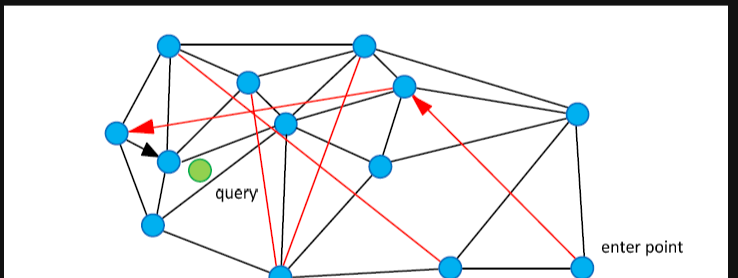
- 红色的是 高速公路, 本质是 指连接相对较远距离的数据点
- 绿色的是 局部连接
- 开始的时候,
nodes数量比较少, 这个时候 搜不到那么近的, 更容易构建 远一点的; M越大, 注意到这个 超参数, 是我们唯一控制 全局连接的概率, 越大, 全局连接的概率越高, 也是 官方算法说 高 dim 的 collection 更适合 大一点的 M ;- 随机算法, 就是构建时候的第3步, 优化, 留
M的时候增加一些 随机性, 这个 我们无法控制,暂时无法介入 ;
先看如何使用这个
NSW图, 高层上看,相邻的都是最近的节点, 用来快速筛选候选集
- 选择一个起始节点:从 NSW 图中选择一个起始节点,可以是随机选择的,也可以是基于某种策略的。将该节点作为当前节点
- 计算距离:计算当前节点与查询点之间的距离。此外,维护一个变量以存储目前找到的距离最近的节点(初始时为起始节点)及其距离
- 遍历邻居: 遍历当前节点的所有邻居,计算邻居节点与查询点之间的距离。
- 如果找到一个距离比目前找到的最近节点还要近的邻居节点,将其设置为新的最近节点, 然后跳回2
- 如果当前节点的所有邻居都比已找到的最近节点距离要远,那么搜索过程结束
- 结果:搜索结束后,最后找到的最近节点即为查询点的近似最近邻节点
- 同样有一个参数
ef控制候选集的大小, 搜索具有 随机性 - 一个参数
k:topK ef >= k: 必须满足,ef一样是效率和精度的取舍
HNSW
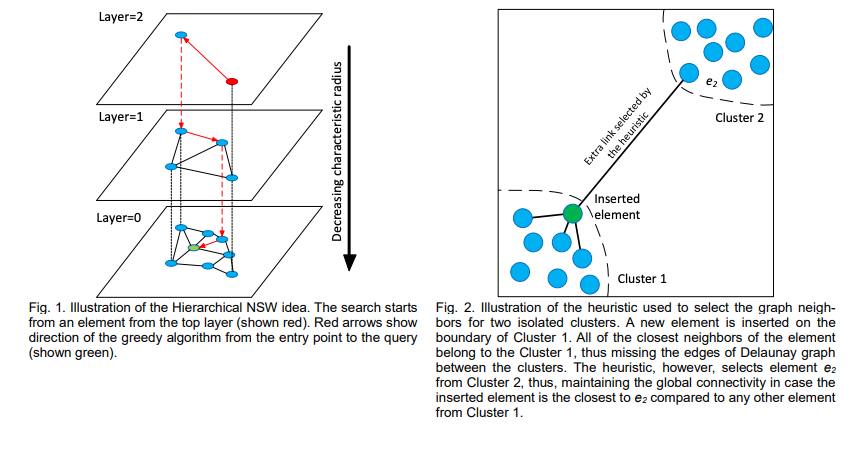
- 上面的高层空间非常稀疏, 构建的时候随机上去, 他们互相距离相对远
-
-
从上跳到下, 最后一层保存全量
-
HNSW 算法的主要思想是将数据点按照一定规则分层,并在不同层次之间建立连接。
这种分层结构使得搜索过程可以从高层次(相当于高速公路)快速跳跃到目标点附近的低层次区域,然后在低层次区域进行精确搜索。
这种从高层到低层的搜索策略大大提高了搜索效率,降低了计算成本
- 加速搜索:通过在高层次建立连接,使得搜索过程可以更快地从一个区域跳跃到另一个区域,从而加速最近邻搜索。
- 降低计算复杂度:高层次的连接相当于快速通道,避免了在低层次区域进行大量的距离计算。这样可以降低整体的计算成本。
- 适应性:
HNSW算法可以根据数据集的规模和密度自适应地调整层次结构,从而在不同数据集上实现较好的搜索性能。
3-In Practice
2个参数.
m和ef,ef代表候选集.
先看 m:
- 这个值大 可能 的作用: 更精确一些,全局连接也会更多,维度高可能要提升一下,然后就是这个值变大,存储一定会变大 ;
- 合理的值大概是
2->100; - 这个值决定了 memory consumption , 真正的占内存会更大;
下面是 m 的一些例子:
- 如果
dim=4那么M near 6是合理的值 - 如果是为了
word embeddingimage vector这种高纬度,M = 48 - 64是不错的值 m的修改往往伴随着ef, 一开始可以简单搞个常数
再看 ef_construction: the parameter is the size of dynamic list for nearest neighbors (use during in the construction)
- 用来控制
index_time / index_accuracy; - 值越大,
index_time_add和index_accuracy_add, 官方的原话是: At some point, increasing ef_construction does not improve the quality of the index - 这个值建议是,
ef=ef_construction, 然后检查recall, 如果< 0.9, 那证明这个值要调整
参数测试代码
import hnswlib
import numpy as np

dim = 32
num_elements = 100000
k = 10
nun_queries = 10

# Generating sample data
data = np.float32(np.random.random((num_elements, dim)))

# Declaring index
hnsw_index = hnswlib.Index(space='l2', dim=dim)  # possible options are l2, cosine or ip
bf_index = hnswlib.BFIndex(space='l2', dim=dim)

# Initing both hnsw and brute force indices
# max_elements - the maximum number of elements (capacity). Will throw an exception if exceeded
# during insertion of an element.
# The capacity can be increased by saving/loading the index, see below.
#
# hnsw construction params:
# ef_construction - controls index search speed/build speed tradeoff
#
# M - is tightly connected with internal dimensionality of the data. Strongly affects the memory consumption (~M)
# Higher M leads to higher accuracy/run_time at fixed ef/efConstruction

hnsw_index.init_index(max_elements=num_elements, ef_construction=200, M=16)
bf_index.init_index(max_elements=num_elements)

# Controlling the recall for hnsw by setting ef:
# higher ef leads to better accuracy, but slower search
hnsw_index.set_ef(200)

# Set number of threads used during batch search/construction in hnsw
# By default using all available cores
hnsw_index.set_num_threads(1)

print("Adding batch of %d elements" % (len(data)))
hnsw_index.add_items(data)
bf_index.add_items(data)

print("Indices built")

# Generating query data
query_data = np.float32(np.random.random((nun_queries, dim)))

# Query the elements and measure recall:
labels_hnsw, distances_hnsw = hnsw_index.knn_query(query_data, k)
labels_bf, distances_bf = bf_index.knn_query(query_data, k)

# Measure recall
correct = 0
for i in range(nun_queries):
    for label in labels_hnsw[i]:
        for correct_label in labels_bf[i]:
            if label == correct_label:
                correct += 1
                break

print("recall is :", float(correct)/(k*nun_queries))- 把数据集合换成真实的 效果好;
- 比如说要优化一个
dim=512- 先固定
M=20- 测试
ef_construction = ef= (50, 60, 70 …) , 判断recall
- 测试
- 如果不达标
M -> 30 -> 40 -> 50
- 先固定
一个 demo 配置, 使用的是
qdrant
client.recreate_collection(
    collection_name="atlas_clip1024",
    vectors_config=models.VectorParams(size=1024, distance=models.Distance.DOT),
    # vector storage on mmap
    optimizers_config=models.OptimizersConfigDiff(memmap_threshold=20000),
    # hnsw index on mmap
    hnsw_config=models.HnswConfigDiff(on_disk=True, m=32),
    quantization_config=models.ScalarQuantization(
        scalar=models.ScalarQuantizationConfig(
            type=models.ScalarType.INT8,
            always_ram=True,
        ),
    ),
    # init_from=models.InitFrom(
    #     collection="atlas_test"
    # ),
    timeout=1000000
)
Refer
- 论文: https://arxiv.org/abs/1603.09320
- 源码: https://github.com/nmslib/hnswlib
- 原理: https://zhuanlan.zhihu.com/p/441470968
- 产品:
Elasticsearch 8.xFacebook fassyMinvsQdrantPgVector- …